

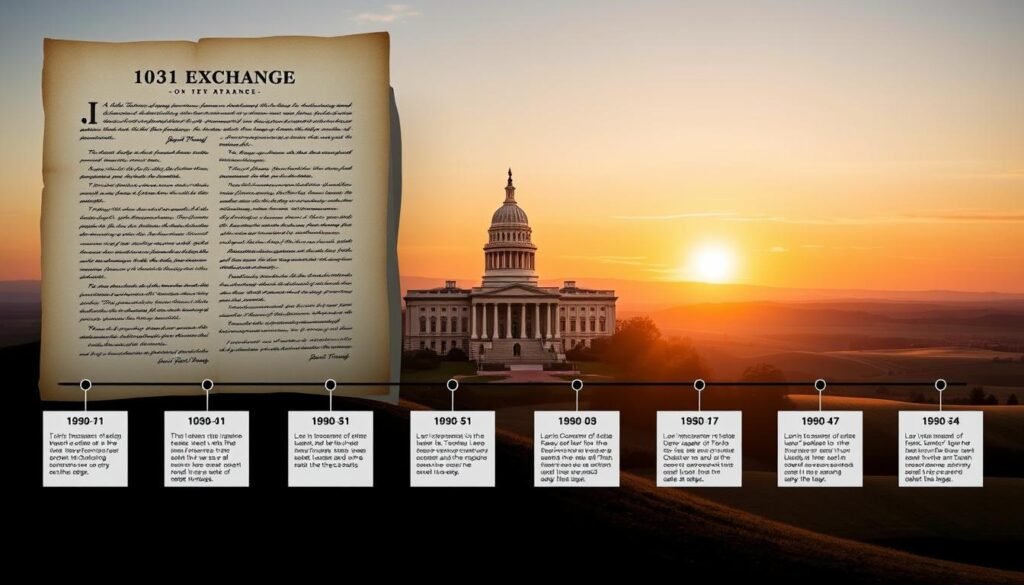
Did you know Section 1031 of the Internal Revenue Code started in 1921? The first income tax code came in 1918, but it didn’t have tax-deferred like-kind exchanges. As real estate grew, so did the need for better tax rules.
Section 1031 lets taxpayers delay capital gains taxes when exchanging certain investment properties. This law has changed a lot over time. It has shaped our understanding of 1031 exchanges today.
Key Takeaways
- The first income tax code was adopted in 1918.
- Section 1031 was introduced in 1921.
- The law has evolved significantly over the years.
- Section 1031 allows for tax-deferred exchanges.
- Understanding the history of Section 1031 is key to its complexities.
The Origins of Section 1031
The story of Section 1031 starts with The Revenue Act of 1921. This law introduced tax-deferred like-kind exchanges. It changed tax policy, letting investors swap certain properties without paying capital gains tax right away.
The Revenue Act of 1921
The Revenue Act of 1921 created Section 202(c) of the Internal Revenue Code. It allowed for exchanging securities and non-like-kind property under specific conditions. It also let investors defer taxes unless the new property had a “readily realizable market value.”
Original Intent and Purpose
The main goal of Section 202(c) was to help investment and economic growth. It allowed investors to change their portfolios without paying taxes right away. This was great during times of economic change, as it made investing easier.
“The provision was designed to allow taxpayers to exchange property without realizing gain or loss, deferring tax until the property is sold in a taxable transaction.”
Early Implementation Challenges
Even though Section 202(c) was new and exciting, it had early problems. Figuring out what was “like-kind” property and how to value exchanges was tough. These issues needed later fixes and changes to make the law work well.
| Year | Legislation | Impact |
|---|---|---|
| 1921 | The Revenue Act | Introduced tax-deferred like-kind exchanges |
| Later Years | Amendments and Clarifications | Addressed implementation challenges and expanded provisions |
As you can see, Section 1031’s beginnings are tied to a big change in law. Knowing where it started helps us understand its uses and benefits today.
Fundamental Principles of 1031 Exchange
To understand a 1031 exchange, knowing its basics is key. A like-kind exchange lets you delay taxes on selling an investment property. You do this by buying a similar property with the sale’s proceeds. This tax strategy has rules to follow for a smooth exchange.
Tax Deferral Concept
The main advantage of a 1031 exchange is delaying taxes on property gains. You can invest the full sale amount in a new property. This way, you avoid taxes right away. It’s great for growing your investment without tax worries.
Investment Property Requirements
To qualify for a 1031 exchange, the property you sell and the one you buy must be for investment. They can’t be for personal use. This rule makes sure the exchange is for business or investment, not personal gain.
The Basis of Like-Kind Exchange
“Like-kind” means the property’s type, not its quality. For real estate, it’s about swapping one property type for another. The 1954 Tax Code Amendment made this clear, now known as Section 1031.
Knowing these rules is vital for a successful 1031 exchange. Following them helps you delay taxes and expand your investment portfolio.
Major Legislative Changes: 1920s to 1970s
Understanding the history of Section 1031 exchanges is key for real estate investors. The 1920s to 1970s were critical for these exchanges.
Early Amendments and Clarifications
The first Section 1031 rule came in 1921. It was simple but unclear on some points. In the 1920s to 1970s, many changes were made to clear up these issues.
These updates made the rules clearer. They helped investors delay paying capital gains tax.
Starker Case and Its Impact
The Starker case was a big deal in this time. It involved T.J. Starker and his son Bruce. They did a delayed like-kind exchange with Crown Zellerback, Inc.
The court ruled in their favor. This made delayed exchanges legal. It gave investors more freedom to manage their properties and delay taxes.
Expansion of Qualifying Properties
In the mid-20th century, more property types could be exchanged. At first, only real property was allowed. But later, other investment properties were included.
This change met the needs of investors as real estate deals got more complex. Knowing these changes helps you as an investor.
By understanding the history and changes in Section 1031, you can make better choices in real estate. This knowledge is key for success in the current market.
The Tax Reform Act of 1984
In 1984, the Tax Reform Act made big changes to Section 1031. It made like-kind exchanges clearer and easier to use.
Introduction of Delayed Exchanges
The Tax Reform Act of 1984 brought in delayed exchanges. Before, exchanges had to happen at the same time. This was hard for investors.
Now, you can sell a property and then find a new one within 45 days. You have 180 days to finish the exchange.
Establishment of Qualified Intermediaries
The 1984 Act also created the role of qualified intermediaries (QIs). QIs help with 1031 exchanges. They hold the money from the sale until you buy the new property.
This way, you don’t get the money right away. This keeps the exchange tax-free for you.
- QIs manage the exchange money, following IRS rules.
- They help with the needed papers, like the exchange agreement and property list.
New Requirements for Property Identification
The Tax Reform Act of 1984 set rules for identifying properties in 1031 exchanges. You must pick possible new properties within 45 days of selling the old one. This must be in writing and signed by you.
The Act also set rules on how many and what value of properties you can identify. This adds structure to the exchange process.
Implementation of Timeline Rules
Success in a 1031 exchange depends on meeting key timeline rules. When you sell a property and plan to buy another, you must follow specific deadlines. This helps defer capital gains taxes.
The 45-Day Identification Period
After selling your property, you have 45 days to find new ones to buy. This is a critical time to look at possible properties. You can pick up to three, or more in some cases, but you must tell your intermediary in writing.
The 180-Day Completion Requirement
After identifying new properties, you have 180 days to buy them. This time includes the 45-day identification period. Planning is key to meet this deadline. The 180-day rule is common in 1031 exchanges, including delayed exchanges.
Consequences of Missing Deadlines
Missing the 45-day or 180-day deadlines can end your 1031 exchange. You’ll then have to pay capital gains taxes on the original property sale. For complex exchanges like reverse exchanges or build-to-suit exchanges, following these timelines is even more important.
To avoid these issues, work closely with a qualified intermediary and tax advisor. They can help you meet all IRS rules and deadlines.
Evolution of Like-Kind Exchange Definitions
Exploring 1031 exchanges can be complex. Knowing how like-kind exchange definitions have changed is key. These changes affect how you manage your investments and taxes.
Real Property vs. Personal Property
There’s a big difference between real property and personal property in like-kind exchanges. At one time, both were eligible. But recent laws have narrowed it down to real property.
Real Property: This includes land, buildings, and structures on the land. The Tax Cuts and Jobs Act of 2017 made real property the only option for like-kind exchanges. This applies to properties held for investment or used in a business.
Personal Property: Personal property is no longer eligible for like-kind exchanges. But, some personal property used in business or for investment was once allowed.
Domestic vs. Foreign Property
The Revenue Reconciliation Act of 1989 made a big change. It stopped like-kind exchanges between U.S. and foreign property. Now, you can only exchange domestic real property for other domestic real property.
| Property Type | Eligible for Like-Kind Exchange |
|---|---|
| Domestic Real Property | Yes |
| Foreign Real Property | No |
| Personal Property (pre-2018) | Yes |
| Personal Property (post-2017) | No |
Changes in Property Classification Over Time
Property classification has changed, affecting how properties are treated under Section 1031. It’s important to understand these changes for effective real estate management.
Commercial Property Considerations
Commercial properties, like office buildings and retail centers, are eligible for like-kind exchanges. You can swap these properties for others, delaying capital gains taxes.
Residential Rental Property Rules
Residential rental properties can also be exchanged. For example, swapping a rental house for an apartment complex can defer taxes on the gain.

Understanding the evolution of like-kind exchange definitions is essential. It helps you make smart decisions about your real estate. Staying current with rules and regulations can optimize your investments and reduce taxes.
The Tax Reform Act of 1986
The Tax Reform Act of 1986 made big changes to Section 1031 exchanges. It changed how investors handled real estate deals. This law was part of a bigger effort to make the tax code simpler and fairer.
Tightening of Requirements
The Act made Section 1031 exchanges stricter. It ended the special tax break for capital gains. Now, all gains were taxed like regular income. This change hurt investors, as it lessened the tax benefits of 1031 exchanges.
Impact on Replacement Property Options
The Act also changed what properties investors could swap for in 1031 exchanges. Without the special tax break, picking the right property became more critical. Investors had to think long-term about their choices.
Changes to Depreciation Rules
The Act also changed how depreciation worked. It stopped fast depreciation and made straight-line depreciation the rule. This change affected how investors figured out their property’s depreciation. It could also change their taxes.
| Change | Pre-1986 | Post-1986 |
|---|---|---|
| Capital Gains Treatment | Preferential rates applied | Taxed as ordinary income |
| Depreciation Method | Accelerated depreciation allowed | Straight-line depreciation required |
Development of Advanced Exchange Structures
Exploring 1031 exchanges reveals advanced structures that boost flexibility and investment chances. These complex plans cater to various investor needs, opening up new paths for tax-deferred growth.
Reverse Exchanges
Reverse exchanges let you buy a new property before selling the old one. This strategy is great in competitive markets where finding the right property is hard. It helps you secure your desired property without the 45-day identification period pressure.
Build-to-Suit Exchanges
Build-to-suit exchanges let you build or improve a new property. This is perfect for investors who want to tailor their properties to fit their goals.

Improvement Exchanges
Improvement exchanges let you swap a property for a more valuable one. The difference in value is deferred through the 1031 exchange. This is great for those wanting to upgrade their properties.
Delaware Statutory Trusts (DSTs) and Tenancy In Common (TIC)
Delaware Statutory Trusts (DSTs) and Tenancy In Common (TIC) allow investors to own parts of real estate. The Treasury Department’s Revenue Ruling 2004-86 made these options possible. They offer a way to diversify investments while deferring taxes.
These advanced structures give you more flexibility and options. Understanding reverse, build-to-suit, and improvement exchanges, as well as DSTs and TICs, helps you make smart investment choices.
The Tax Cuts and Jobs Act of 2017
In 2017, the Trump administration introduced the Tax Cuts and Jobs Act. This law changed Section 1031 exchanges a lot. It affected how investors and businesses use these exchanges.
Limitation to Real Property
One big change was limiting Section 1031 exchanges to real property. Before, Section 1031 allowed for exchanging “like-kind” properties, including real and personal property. Now, only real property held for investment or business use qualifies for a Section 1031 exchange.
This change means that:
- Investors can exchange commercial or residential rental properties.
- Exchanging personal property, like equipment or vehicles, is no longer allowed.
Elimination of Personal Property Exchanges
The removal of personal property exchanges from Section 1031 has big implications for businesses. Before, companies could delay taxes by exchanging personal property used in their operations. Now, they must rethink their asset management.
For example:
- Businesses might need to change their depreciation schedules.
- They might look for other tax planning strategies.
Impact on Business Asset Exchanges
The Tax Cuts and Jobs Act of 2017 has made businesses rethink their asset exchanges. The change to only real property exchanges might make things simpler for some. But it also limits the flexibility businesses had before.
To deal with these changes well, businesses should:
- Check their current assets to find qualifying real property.
- Get advice from tax experts to find new ways to manage assets.
Understanding the Tax Cuts and Jobs Act’s impact on Section 1031 exchanges helps investors and businesses make smart choices about their property deals.
Current IRS Rules for 1031 Exchange Implementation
To successfully navigate a 1031 exchange, you need to know the IRS rules. These rules help ensure you follow the process correctly and avoid taxes. It’s important to understand these guidelines before starting your exchange.
Property Identification Requirements
You have 45 days to identify new properties after selling your old one. This must be in writing and signed by you. The IRS has rules about how many and what value of properties you can pick.
When identifying properties, include their address or legal description. You can choose up to three properties without limits. Or, you can pick more than three if their total value is 200% or less of the old property’s value.
Role of Qualified Intermediaries
A Qualified Intermediary (QI) is key in a 1031 exchange. They manage the sale proceeds to buy the new property. This keeps you from getting the money directly, which is important for tax deferment.
The QI also prepares the needed documents. They make sure the exchange follows IRS rules. Their expertise is vital for a smooth exchange.
Handling Boot and Partial Exchanges
“Boot” is any non-like-kind property you get in an exchange. This can be cash, debt relief, or other non-like-kind items. If you get boot, you might have to pay capital gains tax on it.
Partial exchanges happen when you swap only part of your property. You must split the basis between the exchanged and non-exchanged parts. The IRS guides you on how to do this on Form 8824.
Reporting Requirements and Form 8824
You must report your 1031 exchange to the IRS using Form 8824. This form asks for details about the properties, exchange dates, and any boot. File it with your tax return for the year of the exchange.
The Treasury Department set rules for tax-deferred exchanges in 1990. Knowing these rules and using Form 8824 correctly is key for compliance.
| Form 8824 Line | Description | Example |
|---|---|---|
| 1 | Date of sale of relinquished property | 02/10/2023 |
| 2 | Gross proceeds from sale | $500,000 |
| 18 | Adjusted basis of replacement property | $450,000 |
| 22 | Cash received or other boot | $50,000 |
State-Level Variations and Compliance
Understanding 1031 exchanges goes beyond federal rules. You must also know the state-level variations. As an investor, it’s key to follow all laws and regulations.
State Tax Implications
State taxes can change a lot in 1031 exchanges. Some states follow federal tax laws, while others don’t. For example, California and New York have their own rules. Knowing these differences helps avoid unexpected taxes.
- Some states offer more favorable tax treatment for 1031 exchanges.
- Others may require additional reporting or have different rules for like-kind exchanges.
- Understanding these state-specific rules is essential for a successful 1031 exchange.
Geographic Differences in Implementation
Where you are also matters in 1031 exchanges. The type of property, its location, and local laws can affect the process. Exchanges in different states or countries can be more complex. Plan carefully considering these factors.
Coordination Between Federal and State Requirements
It’s important to follow both federal and state laws for 1031 exchanges. This means knowing federal 1031 exchange laws and state laws where your properties are. For example, a partnership split 1031 or a partial 1031 exchange might have state-specific rules. Staying compliant with both can prevent problems.
Working with experts who know both federal and state tax laws is wise. They can offer advice specific to your situation. This helps ensure a smooth 1031 exchange.
Recent Court Cases and IRS Rulings
Recent years have seen big changes in 1031 exchanges. These changes are key for investors wanting to use Section 1031. It’s important to know about these updates.
Landmark Decisions Affecting 1031 Exchanges
The Starker family case changed how 1031 exchanges work. It showed the need for clear rules for delayed exchanges. This case has shaped how 1031 exchanges are done today.
- Starker Case Impact: Made exchanges easier by allowing for delays.
- Multifamily Exchange: Now, investors can delay taxes by swapping multifamily properties.
Private Letter Rulings and Their Impact
Private Letter Rulings (PLRs) from the IRS shed light on tax laws. For 1031 exchanges, PLRs have made things clearer. They’ve even talked about vacation rental exchanges.
- PLRs guide on complex exchange setups.
- They help investors see the IRS’s view on certain properties, like vacation rentals.
Evolving Interpretations of “Like-Kind”
The idea of “like-kind” has changed a lot. At first, it covered many types of exchanges. But the Tax Cuts and Jobs Act of 2017 narrowed it down to real property.

This change affects investors, like those in multifamily or vacation rentals. It’s vital to keep up with these changes to use 1031 exchanges well.
Conclusion: The Future of Section 1031
Understanding the future of Section 1031 is key for investors and real estate pros. You now know a lot about Section 1031 and its role in investment plans. This knowledge helps you deal with the complex world of 1031 exchanges.
Changes in tax laws and IRS rules will shape Section 1031’s future. These changes might affect what properties qualify and how to do a 1031 exchange. Keeping up with these updates is vital for getting the most from this tax break.
Investing in investment property can grow your wealth with the 1031 exchange. Knowing the law well and adjusting to changes helps you make smart choices. This supports your financial goals over time.
It’s important to watch for law updates and adjust your plans. With the right advice and a deep understanding of 1031 exchanges, you can move forward in real estate investment.